WB2LQF’s Famous Bedspring QSL

I searched many shoe boxes up in the attic over the last week to find this card.  I knew I had it; just didn’t know exactly where.  Look closely at the comment about me having had my foot in a water bucket.  Sam was referring to the fact that I was actually loading my bedspring for this contact.  It was 1966 and this was one of my last contacts before I headed off to the Navy. I had a Knight-Kit T-60 transmitter that used a hardy 6DQ6B for the final.  I had no antenna at this time so I just connected the chassis of the T-60 to the dial stop on our old black rotary phone.  I knew from experience that the phone company had a good ground because my crystal radios always worked better when connected to the phone’s dial stop.  Then I attached a piece of wire to my bed’s spring and stuck the other end into the SO-239 on the transmitter.  God only knows what the SWR was.  I had 60 watts input and no idea of what the output was.  But as the card confirms, we had a nice long CW chat during which I got to tell Sam exactly what was sending my signal to him.

People often joke about “loading a bedspring”.  I actually did it!

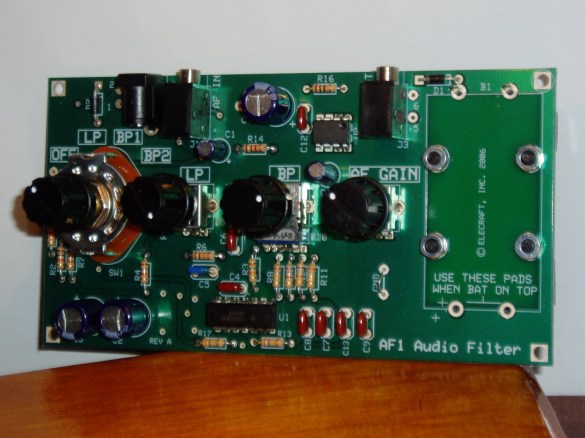
Elecraft AF1 Active Audio Filter and Amplifier

I recently completed an operating accessory that I’ve found quite useful and impressive.  It brings my little KX1 trail radio’s single conversion receiver’s performance right up there next to my K2. 

The Elecraft AF1 is a versatile audio filter that can be used with any receiver or transceiver. It can improve intelligibility of CW, phone, or data signals, and is especially well suited to radios that have inadequate I.F. or audio filtering. The AF1 uses straightforward analog circuitry and no surface-mount components, so it’s an ideal project for first-time kit builders.  I built mine in about 45 minutes and that includes making a cup of tea halfway through. 

A rotary switch on the unit allows you to select a low-pass characteristic with adjustable upper frequency roll-off, or a narrow bandpass characteristic. The bandpass filter offers two levels of selectivity, and its center frequency may be tuned from about 350 Hz to about 950 Hz. The low-pass filter is active during bandpass operation, allowing you to further control the upper frequency response. The output amplifier drives low impedance phones or a small loudspeaker. Power can be supplied via either an on-board 9-V battery or an external supply. An LED indicates power on/off status.

There’s a picture of it at the end of this post but first, I’d like you to listen to it in operation.  The following recording is 45 seconds long.  You’ll hear the unfiltered 40 meter signal of VE3YAA calling “CQ” and then I’ll switch the filter in.  Toward the end of the recording, I’ll switch it out and then back in again.  I’m sure you’ll agree that it really makes the CW pop out.

Click “Hear

Anyone interested in more information can go to the Elecraft website.