Click on the following link to view pictures of the 2010 Christmas Breakfast held at the 84 Diner in Fishkill on Saturday, December 11. All pictures courtesy of Bill Walsh, NG2D.
2010 Holiday Party
I would like to thank EVERYONE who went to the QSY Society breakfast buffet this morning at the 84 Diner… I think everyone had a good time, it sure did sound like it .
During the event, members who exhibited outstanding service to the club were honored with a certificate of appreciation award.
These members are:
Nick N2QZ
Brenda N2TTO
JB WA2WMJ
Dave KC2AFK
Chet AB2FF
Bill NG2D
Stan WB2LQF
Henry KB2VJP
We also had 2 winners in the holiday drawing… Bill, NG2D XYL won a bottle of wine, I hope you enjoy it. Winning the subscription to CQ magazine went to Richard, K2DTE. I am sure you will enjoy this as well.
BTW, if you took photos, plz post them on the blog…
The representatives for Toys for Tots in our area also attended and walked away with some very nice gifts for the children who are in need of some holiday joy. I personally would like to thank everyone who gave today. See, Santa is real!!!
If you could not attend this year, we missed you and hope you can attend next years.
73 & 88
Scott W2NTV
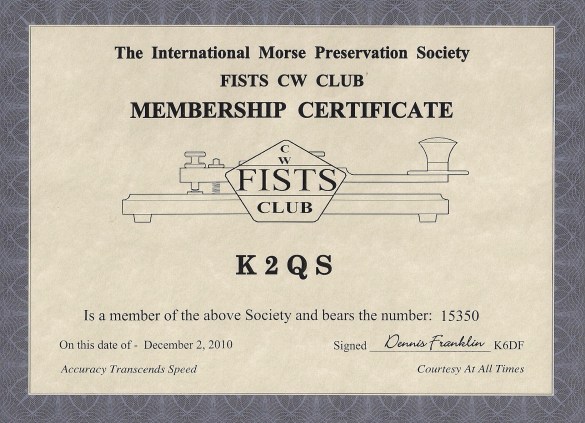
K2QS JOINS FISTS
Effective December 2, 2010 Club Call K2QS is now an official member of International Morse Preservation Society’s FISTS CW Club. K2QS has been assigned the number 15350. Thanks to JB WA2WMJ for arranging this. For CW operators, FISTS has long been the organization to stand behind and support as it goes about preserving and protecting both the history of Morse as well as its future in a digital age.
FISTS provides all levels of operating activities for both old and new operators and the competition is always friendly. Members strive to act as ambassadors of their respective countries and to be recognized as ‘good’ operators. The hallmark of a good FISTS operator is quality not speed and always with emphasis on consideration for other operators.
To learn more about FISTS – or perhaps to join this worthy worldwide organization yourself – visit them here.
Below is The QSY Society’s Membership Certificate.
The “Good Old Days” (?)

WB2LQF's 1960's Vintage Operating Position
The above picture shows my vintage station. To the left is a Heathkit DX-35 transmitter and next to it is a Heathkit VF-1 VFO. On top of the VF-1 is a Drake TV-1000LP Low Pass Filter. In the center is a homebrewed Transmit/Receive relay and next to that is a Drake 2B receiver. To the right of the 2B is a homebrewed wooden speaker enclosure with a real 8 ohm vintage speaker inside! Back in the late Fifties and early Sixties, electronic keyers were little more than concepts, so the average CW op used either a straight key or a semi-automatic ‘bug’. The two non-vintage items in this photo are the MFJ antenna tuner on top of the DX-35 and the MFJ Frequency Counter with its little whip antenna sitting in front.
Those hams too young to remember the pre-transceiver days might be interested in learning what was involved in just making a simple contact back then.
Imagine yourself sitting in front of the softly glowing dial of your Drake 2B in 1964. You’re tuning around the 40 meter band but your display is analog so you have a little button you can press and it sends out a marker signal every 100 kHz. That was how you deduced (approximately) where you were in the band. Better not get too close to the band edge! Aha! There’s someone calling “CQ” and it’s in a portion of the band that your privileges authorize you to operate in!
OK..calm down. You’ve got some work to do. Quick, now turn the VFO to “SPOT” and swing the VFO tuning dial down (or up) to the frequency you’re hearing the CQ on. Now very carefully, tune the VFO so you hear the null. That’s zero beat and that’s where you want to be – sitting right on top of the other guy. He’s sent “K” and now he’s listening but you’re behind the eight ball – you still have to tune your transmitter up.
Reach over and turn the rotary switch on the DX-35 from “Standby” to “Tune”. This sends out an unmodulated carrier. You have two big knobs, marked “Plate” and “Ant”. Adjust the “Plate” knob until the meter monitoring the plate current dips. You don’t want more than about 120 mils on the 6146, not if you plan to use it tomorrow night again. Now adjust the “Ant” knob until you have maximum power going out to the antenna through the transmitter’s “pi-net” output circuitry. Back in the old days, you could usually count on the pi-network to match somewhere between 40-600 ohms impedance. SWR? Hey, as long as nothing catches fire, we’re OK. These 6146s could take it a lot better than today’s sissy transistors! Ah…we’re not done yet. Now we have to switch the meter to “Grid” position and make sure we are not over driving the 6146. Around 35 mils sounds about right.
OK. Good. Surprising as it may seem, after a little practice we could do all this in a matter of a few seconds. So…now we got a guy who just called CQ, we’ve used a 100 kHz marker generator to confirm his frequency, we’ve zero-beat our transmit frequency to his transmit frequency, we’ve matched the transmitter to the load impedance and made certain that we are operating within the final power tube’s parameters. Are we ready to answer this CQ? Almost.
The last job we have to be concerned with is switching the single antenna we have from receive to transmit and making certain we don’t overload the receiver’s front end and blow it up. Those hams with a healthy budget owned Dow-Key Relays; the rest of us often had to make do with a knife switch and a pair of back-to-back 1N34A diodes across the receiver’s antenna terminals so if the RF voltage got too high we could save the receiver. At best, the operator flipped ONE switch to go from receive to transmit and back. But most of us flipped MORE than one – in this case, we have to flip the Drake 2B receiver into “Standby” mode to mute the receiver, then flip the changeover switch to disconnect the antenna from the receiver and connect it to the transmitter, and finally we could flip the transmitter’s switch from “standby” to “CW”.
Now we can put our fingers on the key and answer the “CQ” — but be careful. Your vintage transmitter is either cathode-keyed or grid-block keyed. There may be a couple hundred volts across that key!
ALSO…..there is no such thing as a sidetone with this setup. Remember, the receiver has been muted to save the front end, so now you can send CW the way Mr. Morse intended it to be sent —- listening to the clicks!
Full break-in CW? Fuggedaboutit! Using one of these stations in a modern day contest would be a laughable exercise in futility considering the ¼ to ½ second most ops allow after a CQ before they press their memory buttons and start resending it!
Vintage stations reflect an earlier, wonderful time in the long history of our hobby. Finding, refurbishing, and using vintage equipment is a special little niche among the many, many special interest areas that we have the flexibility to enjoy as hams in the 21st Century.
It can be educational and satisfying for those so inclined but it’s not for everyone, especially in light of the lethal voltages and currents present.
As for my vintage station, I enjoyed restoring it and made many contacts before finally selling it. It was a very satisfying trip down memory lane and made me all the more thankful for the incredible advances in technology that we’ve enjoyed in the ensuing years.
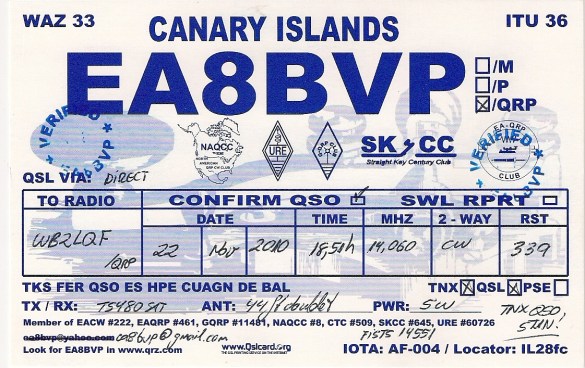
Bearing 086 degrees; Range 3,374 miles
This is my QSL for a recent QRP-to-QRP contact. It’s noteworthy because I was laying out across the couch in my loft with my little KX1 on my chest running 1 watt to a 28′ wire tossed into the top of a maple tree just off my second floor rear deck, with a 33′ counterpoise dropped off the railing to the ground below. Bal had 5 watts and a 44′ doublet. For me that comes out to 3, 374 miles-per-watt. Not too shabby!
 QSY Society